
Local SEO for tradies who work out of a ute, not a shopfront
Plumbers, electricians, builders, plasterers, tilers and waterproofers. Most tradies hide their address on Google because they work from home, and almost nobody tells them what that does to their rankings. This is local SEO built around how a service-area business actually gets found.
Why ranking a trade is a different job
Most SEO advice assumes you have a shop. You don't, and that changes nearly everything.
You're a service-area business, and Google treats you differently
Hide your address on your Google profile and you become what Google calls a service-area business. Your listing stops being anchored to a pin on the map and starts being judged on the service areas you declare, your categories and your reviews. Most tradies hide the address because they work from home, then wonder why they don't appear — nobody told them the rules changed when they ticked that box.
Emergency work and planned work are two different searches
A blocked drain at 7pm and a bathroom renovation in March are not the same customer. One takes the first business that answers, the other reads three websites and checks your licence. If you do both, you need content that serves both — a single page pitched at the middle serves neither.
Your review pace depends on your trade, not your effort
A sparky finishes four jobs a day. A builder finishes four jobs a year. Telling both to "get more reviews" is useless advice. The realistic target for a high-volume trade is weekly; for a builder it's making sure every single completed job turns into one, because you get so few chances.
Your licence is a ranking asset, not fine print
NSW requires your licence number in advertising. Put it on every service page rather than buried on an about page and it does two jobs at once: it satisfies the legal requirement and it answers the question that decides whether a bigger client calls you.
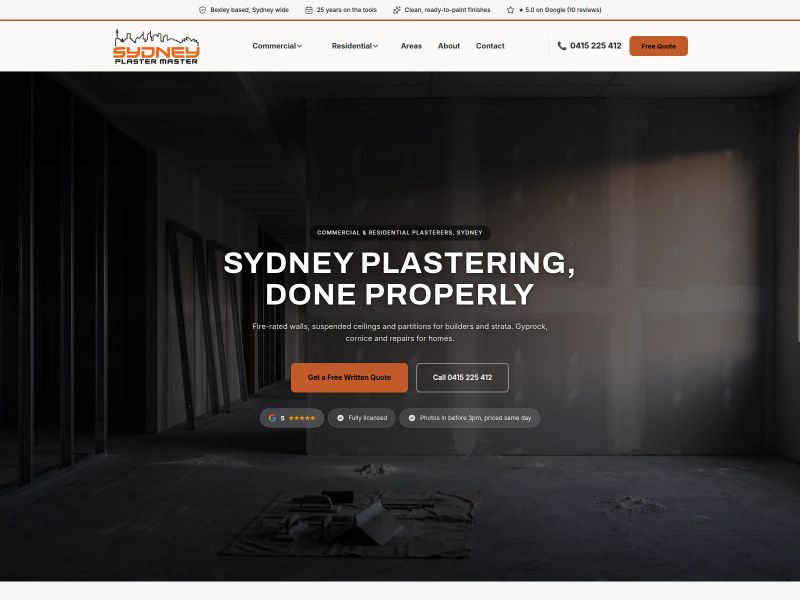
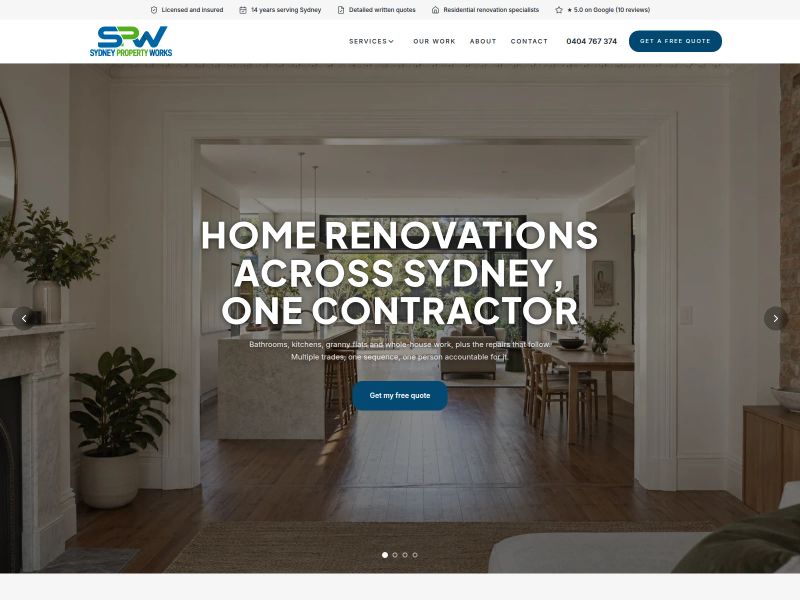
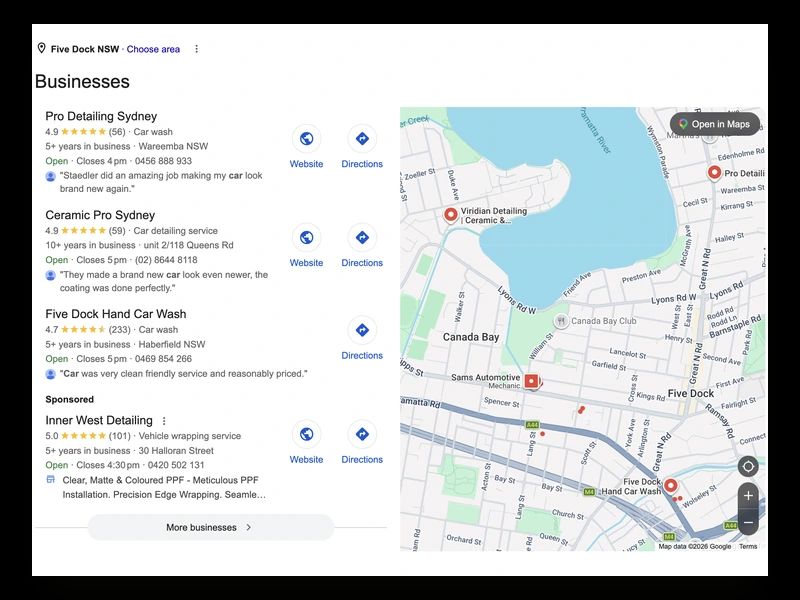
Three Sydney businesses we've done this for
Three different problems, one fix: say where you work, prove you're licensed, keep the reviews coming.
What the work looks like by trade
The mechanics are the same. What you lead with, and how fast reviews accumulate, is not.
Plumbers, electricians and locksmiths
High job volume and a lot of urgent work. Speed of response and a phone number people can tap decide most of it. Reviews should be arriving weekly, and the emergency pages need to load fast on a phone with one bar of signal.
Builders, renovators and granny flat specialists
Few jobs, long decisions, large amounts of money. Nobody books you from a map listing. They read the site, check the licence, look at finished work and then call. Every completed job has to turn into a review because you get so few opportunities.
Plasterers, tilers and waterproofers
Usually subcontracting to builders as well as working direct. That means two audiences on one site: the homeowner searching your trade plus their suburb, and the builder checking whether you're insured and reliable before putting you on a job.
Painters, landscapers and fencing
Heavily seasonal and almost entirely visual. Galleries do more work here than copy does, and year-on-year comparison is the only honest way to tell a ranking gain from a warm spring.
Roofers, gutter and drainage
Weather-driven demand that spikes after storms. Being already visible when it rains is the whole game — the work cannot be done reactively in the week the searches arrive.
Car detailing and mobile services
You travel to the customer, so service areas and booking matter more than an address. Pro Detailing is our worked example: bookings taken online rather than over the phone.
What we actually do on a trade account
Set the service areas properly
Declared service areas on your Google profile, matched by suburb pages on the site. Twenty suburbs listed and no content behind them does nothing. Three suburbs with a real page each is what moves.
Split emergency from planned
Fast-answer pages for the work people book same-day, and evidence-led pages — licence, insurance, finished jobs — for the work they research first. Different pages, because they are different customers.
Licence and insurance on every service page
Licence number, insurance position and any warranty terms stated plainly where the customer is deciding, not buried on an about page. Legal requirement and conversion lever in the same line.
Reviews requested at job close-out
Your direct Google review link, set up for your invoices and close-out messages, with a review pace matched to how many jobs your trade finishes. This is the single biggest lever for a tradie and the one almost nobody runs consistently.
Job photos going up as you work
Before and after shots added to the profile and the galleries as jobs finish. Google rewards an active listing, and a customer comparing three quotes picks the one whose work they can see.
Tradie SEO questions, answered
Should I hide my address on Google if I work from home?
Usually yes, and you need to know what it costs you. Hiding the address makes you a service-area business: your listing is no longer anchored to a map pin, so you lose the proximity advantage near your house and gain reach across the areas you declare. You compensate with declared service areas, suburb pages and review volume. Showing a residential address you don't actually trade from is worse — Google can suspend the listing for it.
How many suburbs should I list?
Fewer than you think. Twenty suburbs declared with no content behind them does nothing. Two or three with a real page each — the work you do there, the kind of buildings, the jobs you've finished — will outrank a list every time.
How long does it take for a tradie?
Google Maps visibility usually moves in 4 to 8 weeks. Organic rankings take 3 to 6 months. No one can guarantee either. Profile and review work moves first. Suburb pages and citations take longer and hold longer. If you're in an urgent trade you often feel the phone change before the rankings report shows it.
I get all my work from word of mouth. Why bother?
Because the referral gets searched. Someone passes your name on and the next thing that happens is a Google search for it. A weak result doesn't stop the referral outright, it just makes the caller hesitate — and on a bigger job, hesitation turns into a second quote.
Is this different from what you do for hipages?
Completely. Hipages rents you leads and you compete on price for each one. This builds an asset you own — rankings and a profile that keep generating enquiries whether or not you're paying a platform that month. Most tradies run both for a while and taper the platform off.
Do I need a new website or can you work with mine?
Depends what you've got. If the site is fast, has room for suburb and service pages, and you can get changes made, we work with it. If it's a one-page template you can't edit, the SEO has nowhere to live and a build comes first.
Do you only work with tradies?
No. We work with service businesses across Sydney — clinics, finance, sports academies and property services among them. Trades are the largest part of the book because the work suits them: clear service areas, clear jobs, and reviews that come naturally at the end of each one.
Where to go next
Pick the suburbs you want, or read the comparison before you choose a platform.
Local SEO across Sydney
The full service this page sits under — how local SEO works, what's included and what it costs.
Local SEO SydneyInner West
Marrickville, Newtown, Balmain and Strathfield. Old housing stock, the heaviest trade search in Sydney, and where most of our client work is.
Local SEO Inner WestWebsite design for tradies
If the site can't hold suburb and service pages, the SEO has nowhere to live. This is the build side.
Tradie websitesWhich builder should a tradie use?
The comparison — Wix, WordPress, Squarespace or a managed build — on bookings, credibility and local SEO.
Best website builder for tradies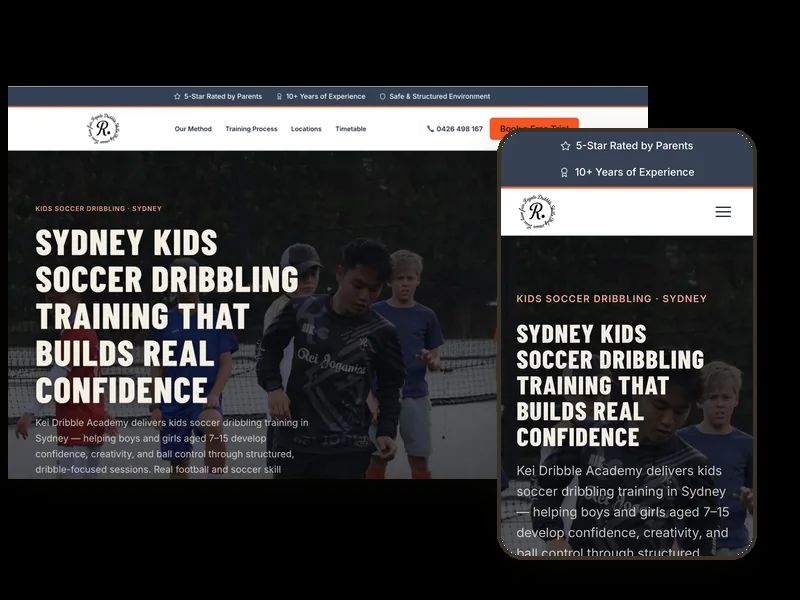
Find out what your trade is actually searching for
Tell us your trade and the suburbs you work in and we'll build your homepage — a real working page, not a sketch — and show you what people search for your trade in those suburbs and who's currently getting the call. Back to you within 2 business days of getting your details. No cost, no obligation. It's a preview: the page stays with us unless you go ahead.